
Standing Seam Panels, Finishes and Snow Retention
A standing seam quote turns on four questions: how the seams lock, how thick and wide the panels are, what the steel is coated with, and how snow will be held on the roof. For metal shingles, exposed-fastener panels or metal over an old shingle roof, see our metal roofing page.
Snap-Lock Panels
On a snap-lock roof, clips are screwed to the deck and each panel's female leg snaps down over the next panel's male leg. No seaming tool is needed, which makes it the cheaper standing seam to install.
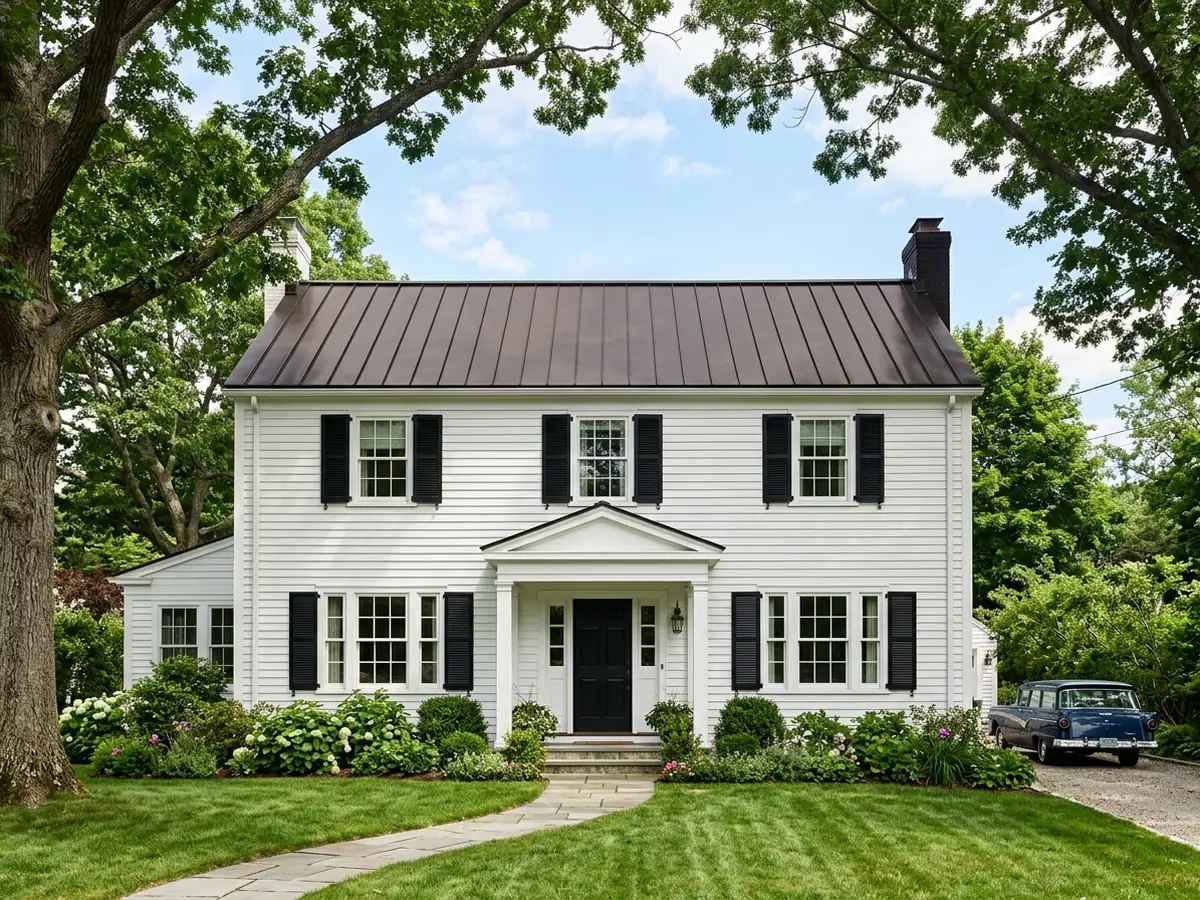
The trade-off is weathertightness. SFS, a roofing fastener maker, rates snap-lock as less weatherproof than a mechanical seam and recommends it for short panel runs on slopes of 3:12 or steeper. That covers most steep gable roofs on colonials, bungalows and Tudors. Supplier profiles commonly run about 16 to 18 inches between seams.
Mechanically Seamed Panels
With a mechanical seam, the panel legs are rolled over each other after the panels are set, either once (single lock) or twice (double lock), by a hand seamer or a motorized seaming machine. SFS calls it the strongest weathertight seal with the best wind uplift values, usable from nearly flat (0 to 3:12) up. On low slopes it recommends the double lock.
Two other details matter on long runs:
- Floating clips let the panels expand and contract along their length. Fixed clips suit short runs only.
- Inseam sealant extends the low end. One supplier's 1.5-inch mechanical seam is rated down to 2:12, and to 1:12 with sealant in the seam.
That's the profile to ask about for a mid-century house with a shallow-pitched roof or a long, low rear slope.
Panel Gauge, Width and Striations
Gauge runs backward: a lower number is thicker steel. HomeGuide says most residential metal roofing is 24 or 26 gauge, and supplier standing seam profiles often start at 24 gauge.
Thickness and width also control oil canning, the waviness you sometimes see across the flat part of a panel. A panel supplier, Sheffield Metals, describes it as an inherent trait of thin cold-rolled metal and a cosmetic issue, not a structural one, and notes that paint and weathertight warranties don't cover it. What reduces it:
- Thicker metal, which moves less.
- Narrower panels, 18 inches or less between seams.
- Striations (pencil ribs or stiffening ribs) rolled into the flat, which don't stop the waviness but break it up so it shows less.
- Lighter, low-gloss colours. Dark, glossy finishes show it most.
If a flat, unribbed look in a dark colour is what you want, ask the contractor how they handle oil canning before you sign.
Paint Finishes and Galvalume
Under the paint, Michigan's code requires a corrosion-resistant coating on steel roofing. The two you'll see are Galvalume (55% aluminum-zinc, ASTM A792 AZ50) and galvanized G90 zinc. HomeGuide notes that Galvalume resists corrosion better than galvanized, which is why it's the usual base for painted standing seam in a non-coastal place like Ann Arbor.
The paint on top comes in two main grades:
- Kynar 500 (PVDF). To carry the name, 70% of the resin must be PVDF. Metal manufacturer McElroy rates it the best paint system against fading and chalking.
- SMP (silicone-modified polyester). About 30% silicone in the resin; McElroy calls it mid-level in both price and performance, and the most widely used.
Our view: on a roof you expect to keep for decades, the colour should last that long too, so PVDF is worth the higher price for most houses. SMP is a reasonable choice on a garage or outbuilding.
Snow Guards and Snow Retention
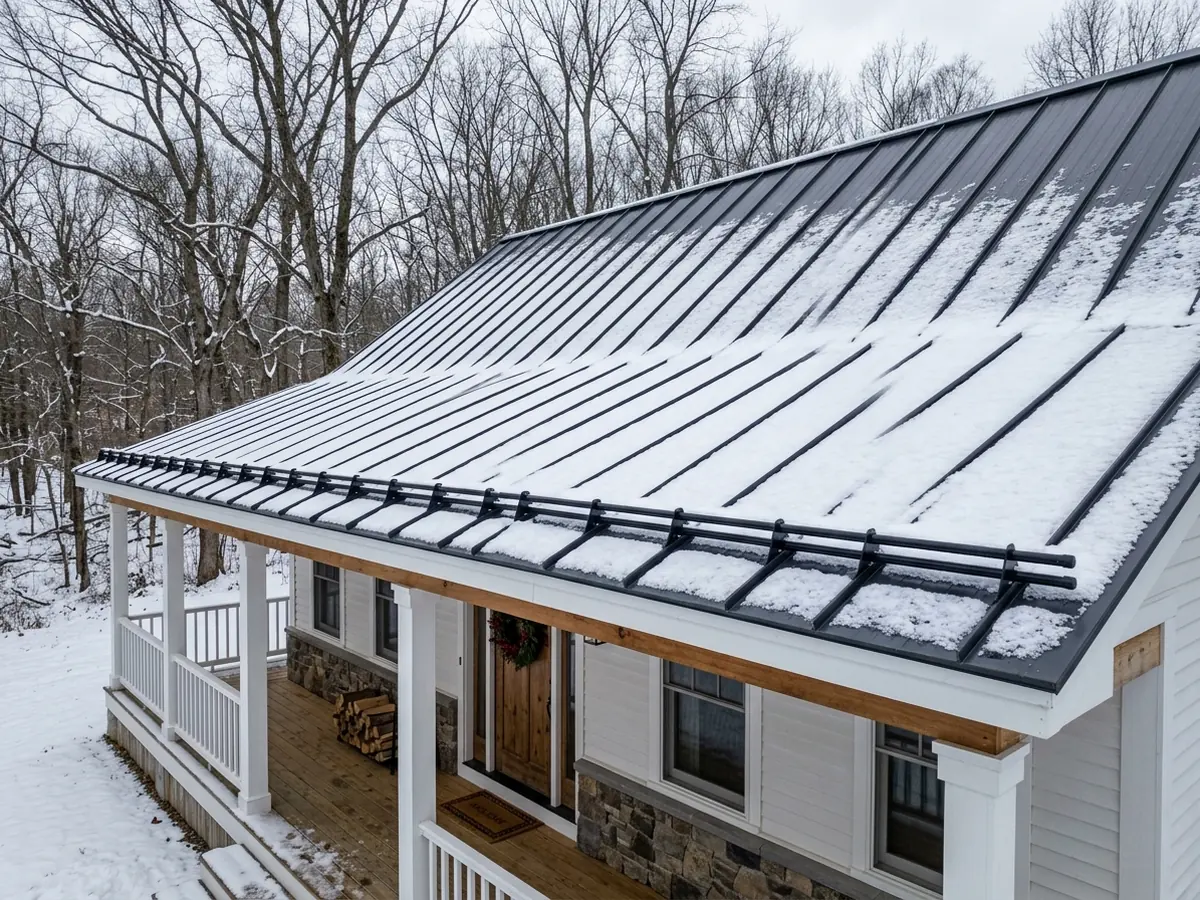
Snow slides off smooth steel in one piece. Snow guards hold it on the roof so it melts and drains off slowly instead of landing on a porch roof, a walkway, a car or a gutter.
Michigan's code sets the ground snow load for the City of Ann Arbor at 20 pounds per square foot, against 25 psf for most of the rest of Washtenaw County. That figure is where roof snow loads start, and it's what a snow retention layout gets engineered against. The guard styles:
- Bar-style guards run horizontal bars across the panels, and heavier loads can call for a second bar.
- Fence-style guards use several bars and stand taller.
- Pad-style guards are individual stops spread over the roof; Sheffield Metals notes they may not hold as well as a continuous bar.
On standing seam, bar systems clamp onto the seams with round-point setscrews that grip without piercing the metal, so no holes go through the roof. How much snow Ann Arbor actually gets in a season is on our ice dam removal page.
Why Ann Arbor homeowners call Ann Arbor Roofing Co.
- Written estimate, free of charge
- Shingle line, underlayment and ice barrier named in the price
- Deck repair priced per sheet before the tear-off
- One independent local roofer per request, not a call list
- No fee to the homeowner for the referral
What Does a Standing Seam Roof Cost in Ann Arbor?
HomeGuide's 2026 national range for standing seam is $9 to $16 per square foot installed, or $13,500 to $40,000 for a typical house. Galvalume standing seam alone runs $800 to $1,300 per square.
Against that, HomeGuide gives metal roofs a 30 to 80+ year life, against 15 to 30 for asphalt. Things that move a standing seam quote:
Profile
: snap-lock or mechanical, single or double lock.Gauge and width
: 24 gauge costs more than 26; narrower panels mean more seams.Paint system
: PVDF over SMP.Roof shape
: every valley, hip, dormer and chimney means more cut panels and custom trim.Snow guards
: how many eaves sit over a door, walkway, deck or lower roof.
How a full replacement is permitted and torn off is on our roof replacement page; if you're comparing against shingles, see asphalt shingle roofing.
Can Standing Seam Go on a Low-Slope Roof?
Yes, down to a quarter inch of rise per foot. Michigan's residential code sets the minimum pitch for standing-seam roof systems at 1/4:12, far below the 3:12 it requires for lapped metal panels without sealant. The code minimum isn't the whole answer, though: the panel itself has to be rated for the pitch, which on a shallow roof points to the double-locked mechanical seam described above.
That makes standing seam one of the few options, besides a membrane, for the shallow roofs over additions, porches and mid-century houses. If the roof is truly flat, though, compare it with an EPDM or TPO membrane on our flat roofing page. Planning panels on top? Standing seam is covered on our roof replacement with solar panels page as well.