
Emergency Roof Repair: What Gets Covered First
An emergency job isn't a roof repair yet. It's a holding action. Nobody can rebuild decking in a thunderstorm or match shingles at night, so the goal for the first visit is narrow: stop more water getting in, make the damage safe, and leave the roof in a state an insurance adjuster can still read.
Emergency Roof Tarping
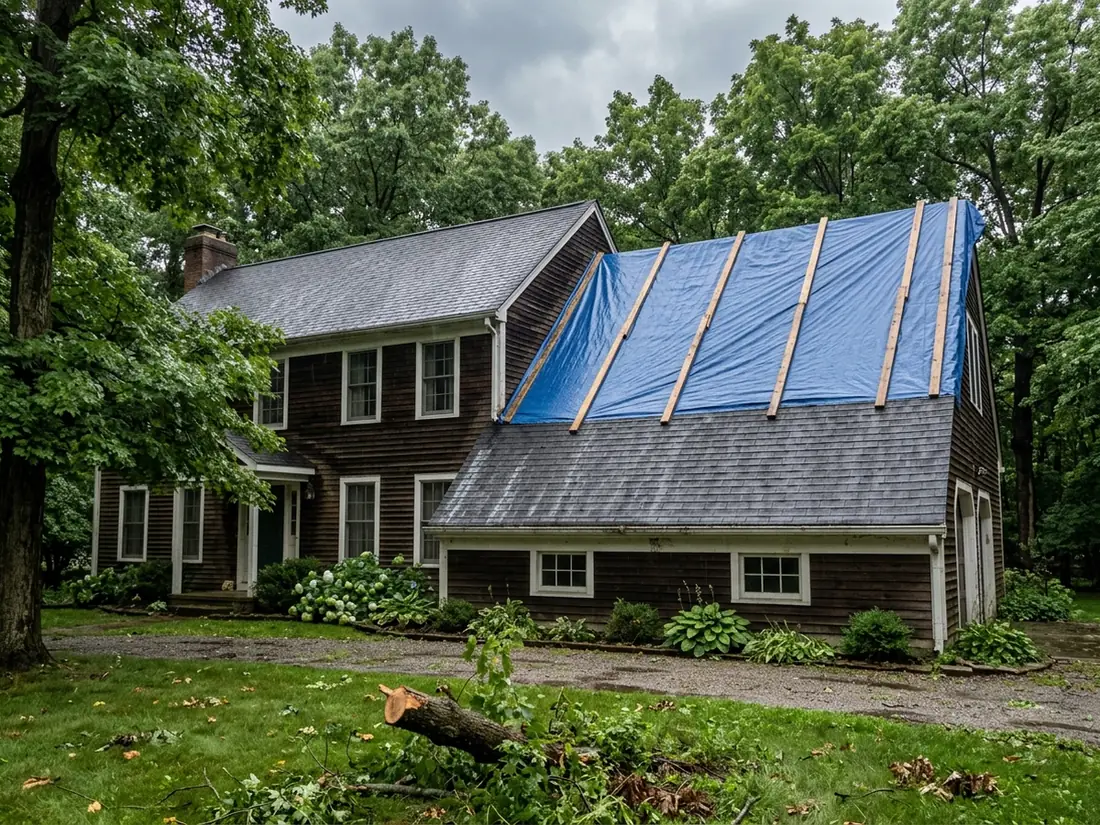
A tarp done well looks fussy. Angi's tarping guide has it covering the damaged area with three feet of extra on every side and running four feet over the ridge, so water coming down the far slope can't get under its top edge. Big holes get plywood screwed over them first, so the tarp doesn't sag into a pond. The top end is rolled around a wood batten, more battens run straight down the slope about six feet apart, and they're nailed through to the deck roughly every two feet. Battens never go in a valley, where they'd dam the water.
The material matters too. When the U.S. Army Corps of Engineers covers storm-damaged houses for FEMA, it uses fiber-reinforced sheeting, not the thin hardware-store kind. Its contractors also won't tarp slate, clay tile or asbestos roofs, because nailing through them breaks more than it saves. Older slate roofs here deserve the same caution, and often a slate specialist (see slate roof repair).
Tree and Limb Strikes
Under a canopy of mature oaks and maples, a hole in the roof often starts with a falling limb. A large limb can crack rafters as well as decking, so before anyone climbs up, the contractor looks from the attic and the ground to see whether the framing still carries load. The tree comes off before the tarp goes on. Cutting a trunk off a roof is tree-service work with rigging, not a roofer's job with a chainsaw.
On insurance, the Insurance Information Institute says a standard homeowners policy covers the damage when a tree hits the house, no matter whose yard it grew in. Removing the tree is usually covered only up to about $500 to $1,000, and damage from a tree you let rot ("poor maintenance") isn't covered at all. Keep the tree service's bill separate from the roofing bill.
Wind Blow-Offs and Exposed Decking
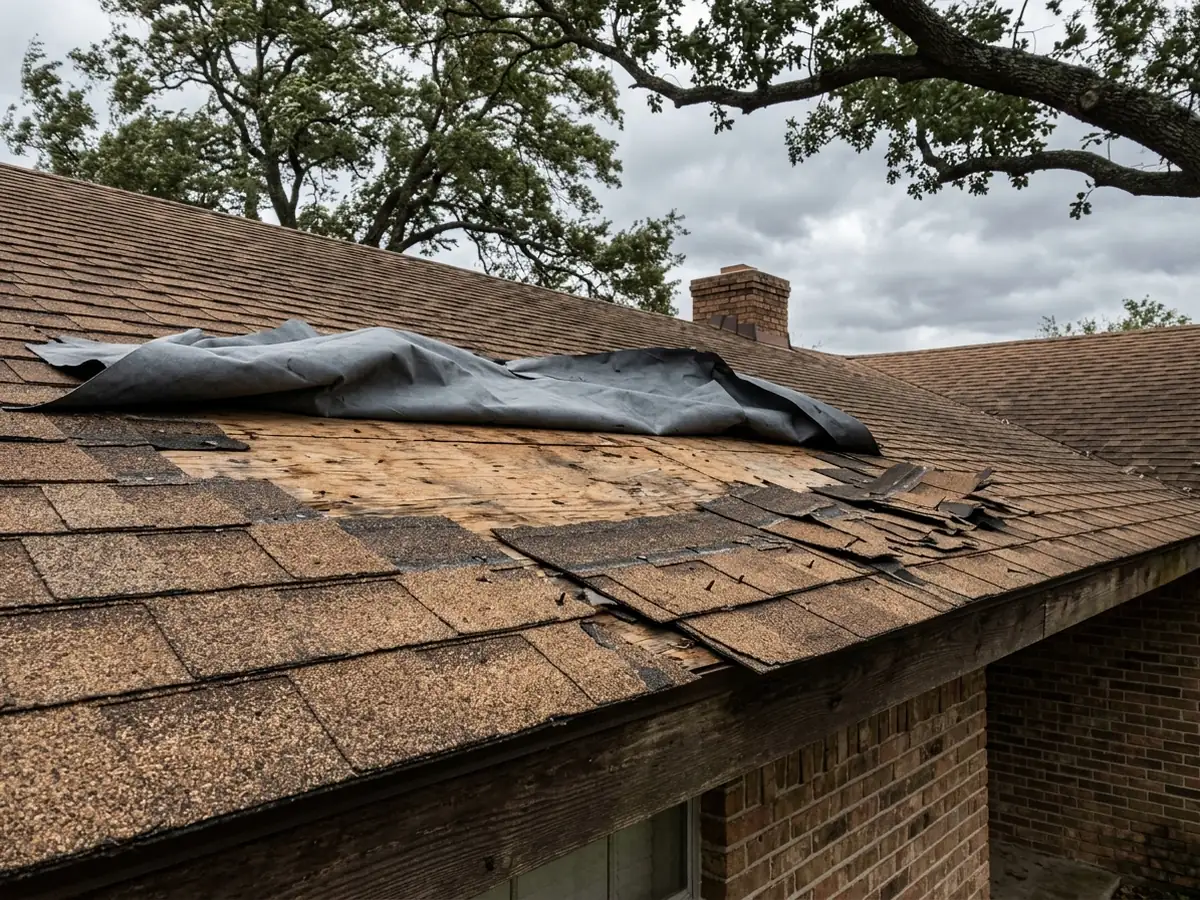
Wind damage often starts at an edge: the rake, the eave or the ridge cap. Once one course lifts, the next goes faster. Where only shingles are gone and the underlayment is still on, a few hours of light rain may do no harm, but bare plywood soaks up water and swells along its seams. The quick fix is sheeting over the exposed area and nailing down anything flapping, since loose shingles tear free in the next gust. Thunderstorm winds have hit 70 mph in the city itself; the storm damage roof repair page has the local record and how hail and wind claims work.
Active Leaks and Interior Water
Inside, the order is: power, then water, then the roof. If water is running near a light fixture, a ceiling fan or an outlet, shut off that circuit at the panel before touching anything. A ceiling bulging with water can be drained on purpose with a small hole and a bucket underneath, which beats having the drywall give way on its own. Then move furniture, put towels down, and take photos.
From the attic, the contractor follows the water upslope to where it gets in. That's often not above the stain. Water runs along rafters and the underside of the deck before it drips, so a stain by a wall can start at a vent boot or a chimney several feet away. The point where it enters is what gets covered or sealed for now.
Winter Leaks Behind Ice
A leak in January with no storm in sight is often an ice dam. Meltwater backs up behind ice at the eave and gets under shingles that only shed water running downhill. Tarping doesn't help here. The fix for the day is steaming channels through the ice so the water can drain, and the lasting fix is in the attic. Our ice dam removal page covers both.
Why Ann Arbor homeowners call Ann Arbor Roofing Co.
- Written estimate, free of charge
- Shingle line, underlayment and ice barrier named in the price
- Deck repair priced per sheet before the tear-off
- One independent local roofer per request, not a call list
- No fee to the homeowner for the referral
What to Do in the First Hours After Roof Damage
stay off the roof, protect the inside of the house, photograph everything, and get the opening covered as soon as it's safe. Michigan's insurance regulator lists "boarding up or covering damaged property" as part of a policyholder's duty to limit the loss after a claim, so a tarp isn't optional.
A sensible order:
- 1
Stay on the ground
OSHA calls falls one of the most common causes of serious work injuries and deaths, and that's for people with harnesses. A wet, torn roof in the dark is worse. - 2
Photograph before anything is moved
The roof from the ground, the attic, the ceilings, the limb on the roof. Angi's tarping guide makes the same point for claims. - 3
Call your insurer
and write down the claim number. The DIFS deadlines for insurers are on the storm damage page. - 4
Get the opening covered
Keep the receipt and the photos of the tarp for the claim file. - 5
Hold off on the permanent repair
until the adjuster has seen the damage, unless they tell you to go ahead.
A request through Ann Arbor Roofing Co. goes to one independent local roofing contractor. We don't send crews ourselves. The contractor comes out, covers what can be covered, and gives you a free written estimate for the permanent repair.
What Does Emergency Roof Tarping Cost?
Angi's 2026 figures put the national average for roof tarping at $450, with jobs running from $150 to $3,300. Most fall between $0.70 and $2.80 per square foot of covered area, and last-minute emergency calls sit at the top of that, $1.00 to $2.80 per square foot.
Size is the big one. A torn-off patch near the eave is a small job; a whole slope after a limb strike isn't. Steep two-story roofs take more rigging and time, and a call at night, on a weekend or right after a storm, when every crew in town is busy, costs more. Plywood over a hole, tree removal and water cleanup inside are billed apart from the tarp.
Ask that the tarping and the permanent repair go on separate lines. The adjuster will want to see them apart, and you'll know what the cover-up cost.
See roof repair in Ann Arbor for leaks that can wait for a dry day, and roof inspection for a full look once the emergency is over.