Eave Repairs, Board by Board
The eave is three parts. The fascia is the vertical board along the roof edge that the gutters hang on. The soffit is the underside of the overhang, between the fascia and the wall. Behind both sit the rafter tails, the ends of the roof framing. Water from a clogged gutter or an ice dam works into all three, usually starting at a corner or under a downspout outlet.
Fascia Board Replacement
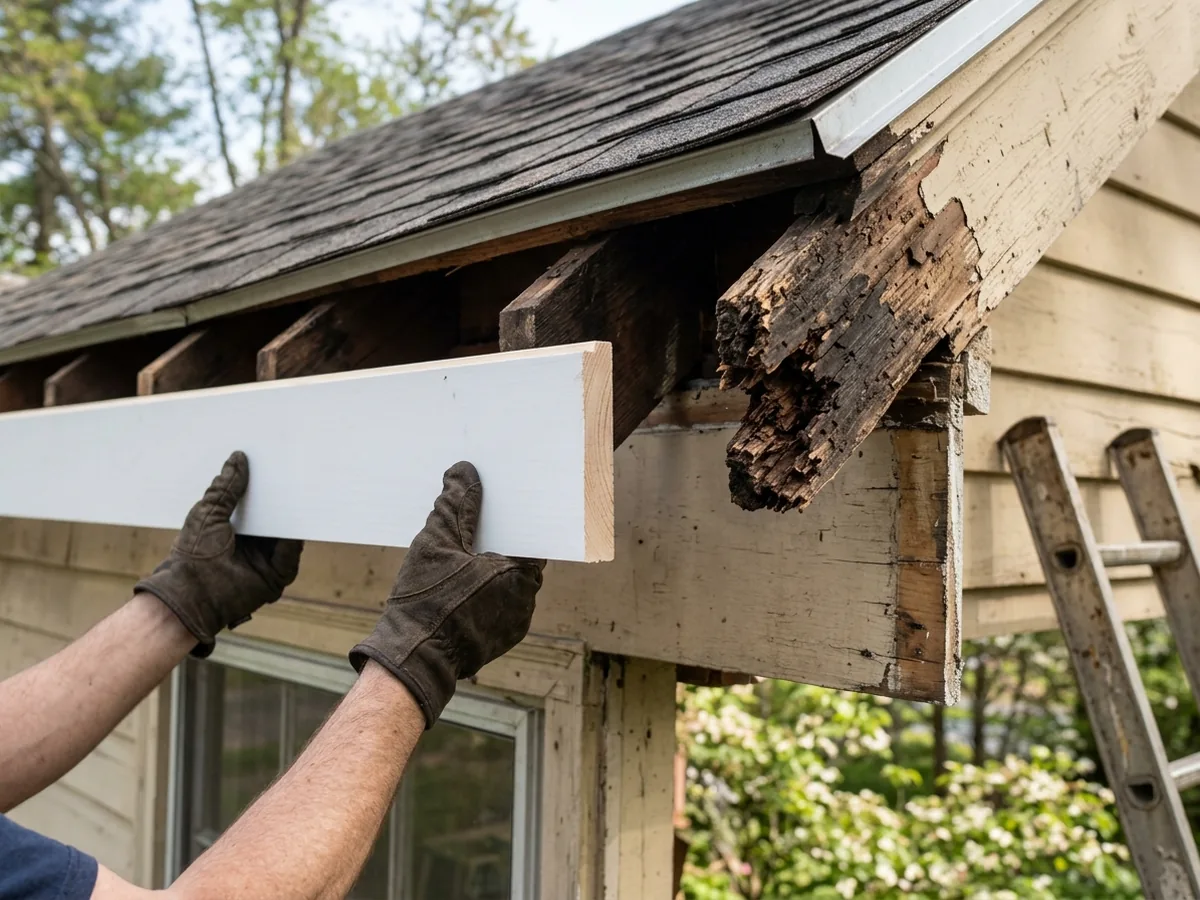
Soft, dark or split wood behind the gutter, paint that peels in one stripe, or a gutter that won't stay tight are the usual signs. The contractor takes the gutter down, cuts the fascia back to sound wood, and fits a new board. Primed pine, cedar and PVC trim board are the common choices; PVC doesn't rot, and wood takes paint to match an older house. Then the drip edge and gutter go back up.
HomeGuide's 2025 guide puts fascia repair at $5 to $12 per linear foot, or $500 to $2,400 for a typical one-story house. If the rot has reached the rafter tails, the price rises: $650 to $1,000 to rebuild them along one side of the house, or $2,000 to $4,000 for a whole roofline.
Soffit Repair and Replacement
Soffit fails from the outside in. Water runs back off a rotted fascia, along the underside of the overhang, and stains or sags the panels. On older houses the soffit is often painted plywood or tongue-and-groove boards; on later ones, vinyl or aluminum panels in a J-channel.
HomeGuide prices soffit work at $4 to $22 per linear foot, or $400 to $4,400 for a one-story house, depending on width and material. Replacing soffit and fascia together runs $9 to $34 per foot, or $900 to $6,800 for a full replacement. Material alone, per foot: wood $3.50 to $8.50, PVC $2.50 to $7.50, aluminum $3.25 to $7.50.
Vented vs Solid Soffit
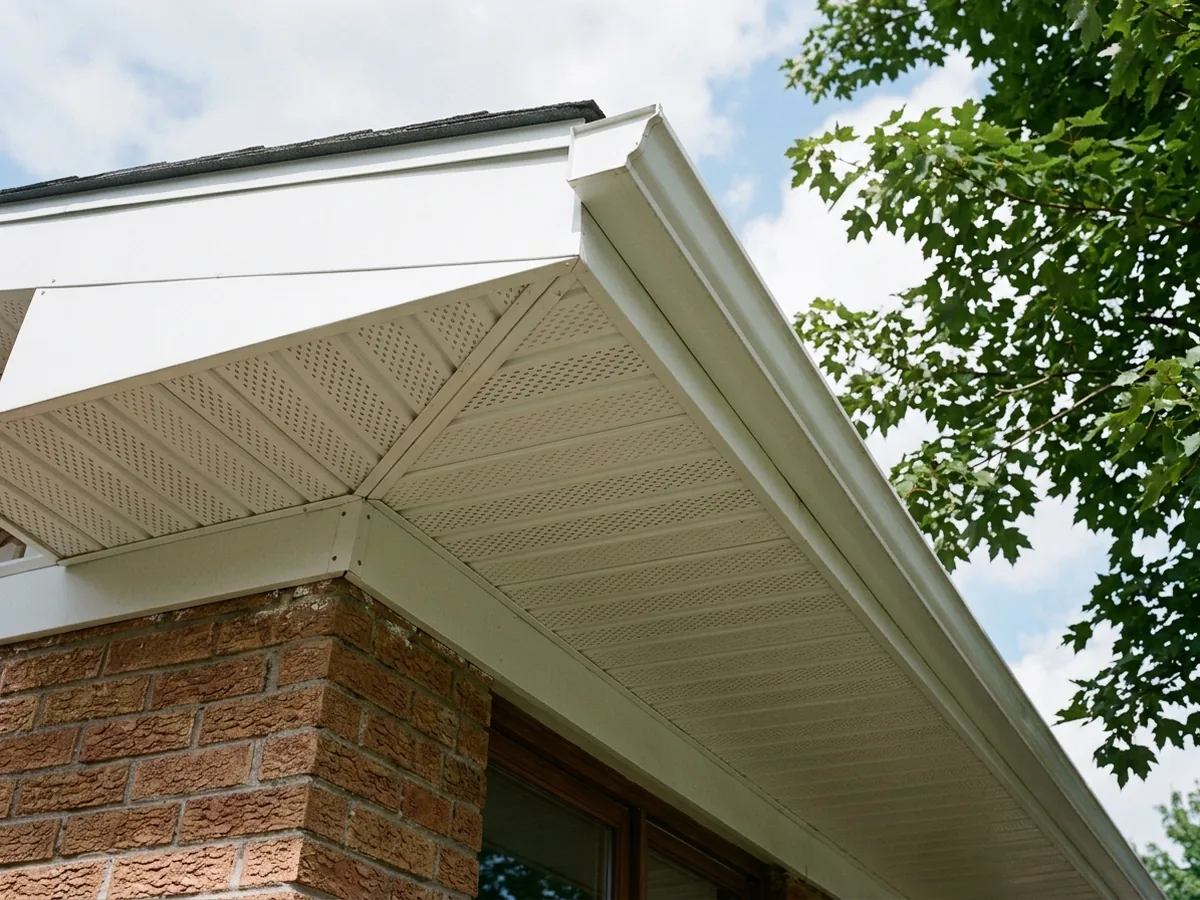
Solid soffit seals the overhang. Vented soffit, perforated panels or a continuous strip vent, lets outside air into the attic at the eaves, where it rises and leaves through a ridge or roof vent. On a house with solid soffit and a ridge vent added later, the vent has nothing feeding it.
Our view: a soffit replacement is the cheapest moment to add intake, because the panels are coming off anyway. Two cautions. Vented panels do nothing if attic insulation is packed against the roof deck above them, so the contractor should check for baffles from inside the attic. And intake has to be balanced with exhaust. How much vent area an attic needs, and where it goes, is on our roof ventilation page.
Aluminum Fascia Wrap
Wrapping, or capping, means bending painted aluminum coil stock over the wood fascia so the wood never needs paint again. It looks clean and lasts. The risk is what's underneath. Our view: never let anyone wrap over soft wood. Rot keeps spreading under the metal, out of sight, until the gutter screws pull out. Ask for the rotted boards to be replaced first, and for the wrap to tuck under the drip edge so water can't get behind it.
Animal Damage at the Eaves
Squirrels chew soft soffit corners and the gap where the soffit meets the fascia; raccoons pry loose panels; birds and wasps nest in any opening. HomeGuide lists nest removal at $125 to $700.
Bats are their own case in Michigan. The DNR says bats can get through a slot half an inch wide, that eaves and soffits are where to look, and that bats are protected, so lethal control isn't allowed except for human safety. It also says to avoid sealing them out during the maternity season, typically May to mid-August, so flightless young aren't trapped inside. The approved method is one-way doors, then permanently sealing the gaps with hardware cloth, caulk or metal flashing. If bats are in the attic, a licensed nuisance animal control company handles the exclusion; the soffit and fascia repair follows.
Why Ann Arbor homeowners call Ann Arbor Roofing Co.
- Written estimate, free of charge
- Shingle line, underlayment and ice barrier named in the price
- Deck repair priced per sheet before the tear-off
- One independent local roofer per request, not a call list
- No fee to the homeowner for the referral
Lead Paint on Older Eaves: What the EPA Rule Requires
If your house was built before 1978 and the fascia or soffit is painted, the EPA's Renovation, Repair and Painting rule applies. Anyone paid to do work that disturbs painted surfaces in a pre-1978 home must be certified, firm and workers alike, even a one-person business. Much of Ann Arbor's housing predates that cutoff (the numbers are on our Ann Arbor Roofing Co. homepage).
What that means on an eave job:
It covers roofing work
The EPA says that if hammering painted parts, even from the unpainted side, disturbs paint and makes dust or chips, the rule applies.The small-job exemption is small
Exterior work that disturbs 20 square feet or less of paint is exempt. Replacing fascia along one side of a house is usually well past that.Containment
For exterior work, the ground must be covered with plastic sheeting extending 10 feet beyond the work area, or farther if needed to catch debris. Within 10 feet of a property line, the firm must put up vertical containment, which matters on the closely spaced lots of the older neighborhoods.Rentals aren't exempt
Owners working on their own home are exempt, but the EPA says the rule does apply if you rent all or part of the house.
Ask the contractor for the firm's lead-safe certification before work starts, and expect containment and cleanup to show up as a line in the estimate.
Repair or Replace the Whole Eave?
Repair a section when the rot is local, usually one corner or the stretch under a downspout, and the rest of the fascia is sound. Replace the full run when the boards are soft in several places, when the gutters are being replaced anyway, or when you want vented soffit all the way around. Doing eaves and gutters in one job saves taking the gutters down twice.
Fascia rot under the gutters often means water is getting behind them. See gutter repair for leaks and pitch, and gutter installation if the gutters are coming off for good. If the rot started with ice at the eaves, see ice dam removal.