
Chimney and Wall Flashing: The Parts That Leak
The 2015 Michigan Residential Code puts it in one sentence: flashing goes at wall and roof intersections, at every change in slope or direction, and around roof openings, and if it's metal it must be corrosion-resistant and at least 26-gauge galvanized or the equivalent. A chimney meets the roof on four sides, so it tests every part of that rule at once.
Step and Counter Flashing
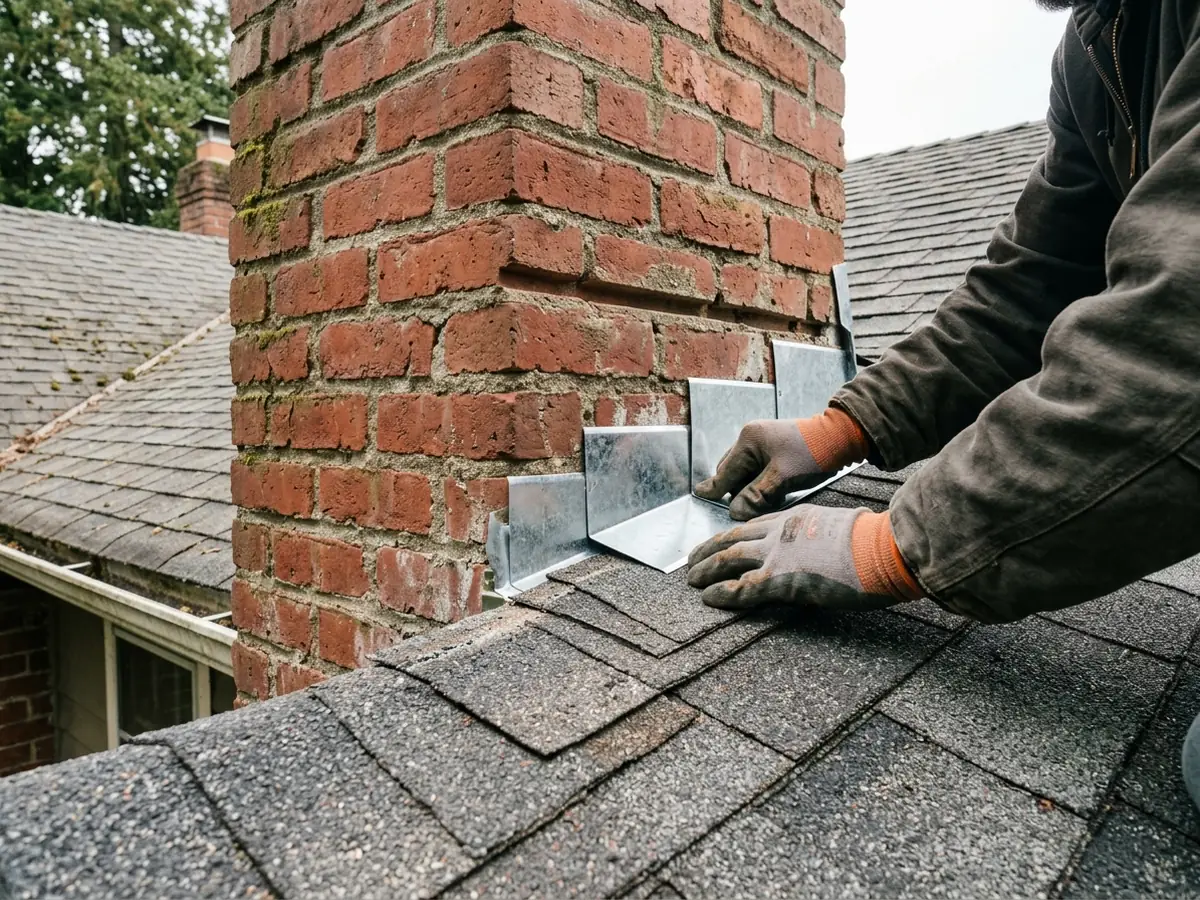
Step flashing is a row of small L-shaped pieces, one per shingle course. Each piece lies on a shingle, turns up the side of the chimney, and is covered by the next shingle up, so water hitting the brick runs down from piece to piece and out onto the roof. It's the base layer.
Brick and roof framing move at different rates, so the steps aren't fastened to the masonry. Counter flashing covers its upturned edge, fixed into the chimney and lapping down over the steps. The two layers slide past each other as the house settles and the seasons change. Michigan's code leaves the details of chimney flashing to the shingle maker's printed instructions. HomeGuide's flashing guide describes the same pairing: counter flashing over the steps as a second layer, its top edge set into the mortar joints.
The common failures: rusted steps on an old roof, steps that were reused under new shingles instead of replaced, and counter flashing face-nailed to the brick and sealed with caulk that cracks within a few winters.
Reglet-Cut Counter Flashing
The best counter flashing doesn't sit on the face of the chimney. It goes into it. A reglet is a slot cut into a mortar joint with a grinder. The top edge of the counter flashing is bent and tucked into the slot, wedged, and sealed with a masonry-rated sealant. Water running down the brick passes over the flashing instead of behind it.
On a chimney, counter flashing usually steps up the side in pieces that follow the mortar courses, each tucked into its own joint. Surface-mounted strips held on with screws and a caulk bead along the top are the shortcut you'll see on many roofs. They work until the caulk fails, and then water gets straight in behind the metal. When the mortar itself is crumbling, the joint needs repointing before any reglet will hold.
Chimney Crickets (Saddles)
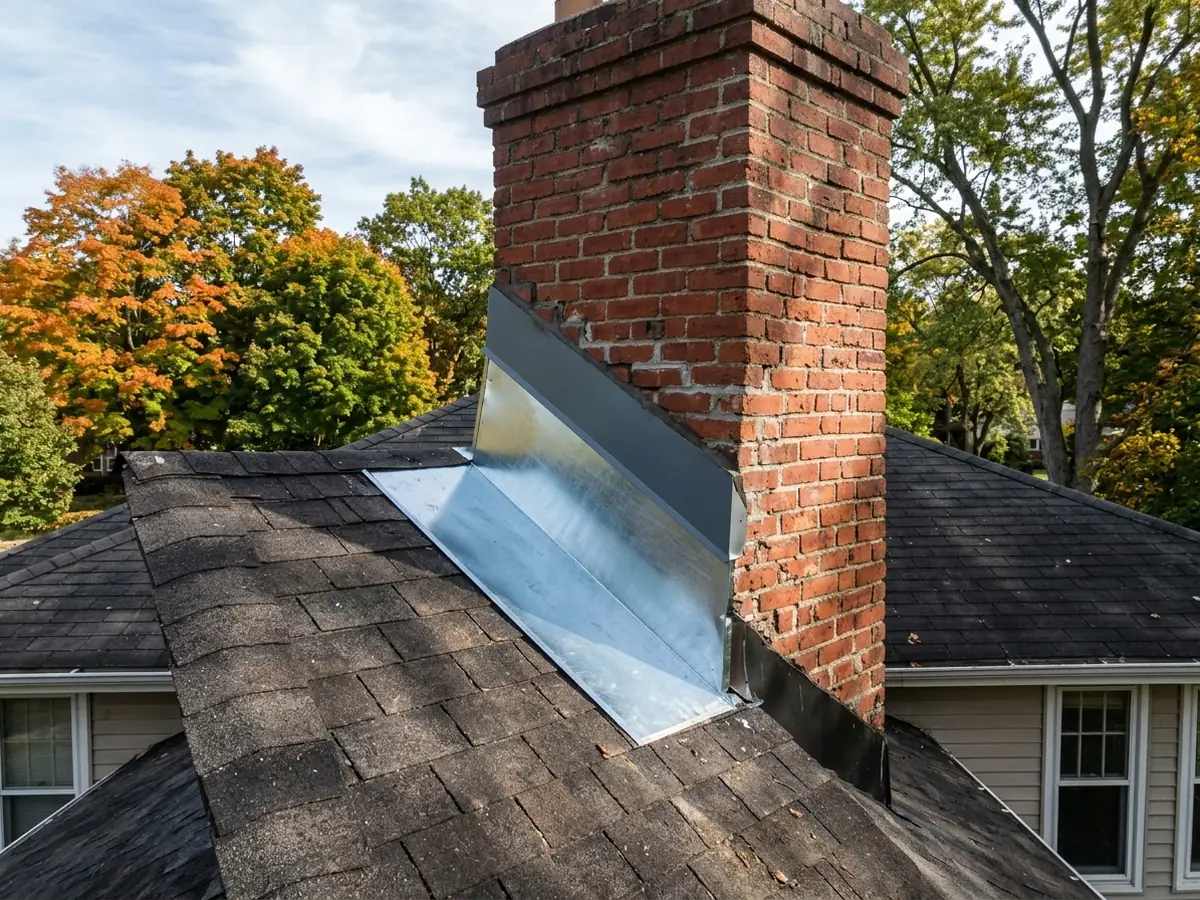
The uphill side of a chimney catches everything coming down the slope: rain, meltwater, leaves. On a narrow chimney, a backer flashing handles it. On a wide one, water and debris pile up against the brick. Michigan's code requires a cricket on the ridge side of any chimney or penetration more than 30 inches wide, measured across the slope, covered with sheet metal or the same material as the roof.
The code's chimney chapter goes further and sets the cricket's height by roof pitch. On a 12:12 roof, the cricket rises half the chimney's width; on 6:12, a quarter; on 4:12, a sixth. A cricket built too flat holds snow, and its seams with the chimney have to be flashed and counter-flashed like any other side. Plenty of older chimneys were built without one. Adding a cricket is normally part of re-flashing a wide chimney, not an extra.
Chimney Caps and Crowns
A leak that shows up around the chimney inside the house, with sound flashing outside, often starts at the top. Michigan amended the model code here. Its version of R1003.9.1 requires a masonry chimney's cap to be concrete, metal or stone, sloped at least 10 degrees, at least 2 inches thick at the edge, overhanging the brick by 2 inches with a drip slot, and set on a bond break so the cap and chimney can move apart. Metal caps lap 4 inches down the sides.
Crowns that were troweled flat with mortar crack, hold water, and let it into the brick, where freeze-thaw does the rest. A rain cap over the flue, the screened metal hood people often mean by "chimney cap," keeps rain and animals out. The code asks that its open area be at least four times the flue's, so the chimney still draws.
Sidewall and Headwall Flashing
The same rules apply where a roof meets a wall: dormers, a second-story wall above a porch roof, a garage tied into the house. The code calls for base flashing at least 4 by 4 inches, continuous or stepped, with its vertical leg tucked under the siding. At the bottom of a sloped roof against a wall, it also wants a diverter (often called a kick-out) so water lands in the gutter instead of behind the siding.
Headwalls, where the top of a roof meets a wall above it, get a continuous apron flashing bent over the last shingle course and tucked under the siding. A missing kick-out shows up as rotted sheathing and stained siding below the roof edge, often years before anyone notices from inside.
Why Ann Arbor homeowners call Ann Arbor Roofing Co.
- Written estimate, free of charge
- Shingle line, underlayment and ice barrier named in the price
- Deck repair priced per sheet before the tear-off
- One independent local roofer per request, not a call list
- No fee to the homeowner for the referral
How Much Does Chimney Flashing Repair Cost?
HomeGuide's 2026 guide puts chimney flashing repair at $300 to $1,800, depending on chimney size, metal and access. Small fixes like resealing a lifted edge run $200 to $500. Full replacement on a large chimney reaches $1,800 or more. Copper costs $15 to $30 per linear foot against $5 to $10 for aluminum.
A wide chimney needs more pieces and, past 30 inches, a cricket. Crumbling mortar means repointing before any reglet is cut, which is masonry work on top of the flashing. Copper costs more but is the right match on slate and on many houses in historic districts (see slate roof repair). Steep roofs add safety setup.
One independent local roofing contractor gets your request, looks at the chimney from the roof and the attic, and writes up a free estimate. Ann Arbor Roofing Co. passes the job on; it doesn't do the work.
Should Chimney Flashing Be Replaced With a New Roof?
Yes, when it's worn. Michigan's re-roofing section says existing flashings, edgings, vents and outlets must be replaced where they're rusted, damaged or deteriorated. A new roof laid against old step flashing wears out at the chimney first.
Our view: step flashing should be new with every tear-off, because it's cheap and woven into the shingles. Good reglet-set counter flashing, especially copper, can often stay if it's lifted carefully and reset. If an estimate says the old flashing will be "reused" without saying it was checked, ask.
See roof repair in Ann Arbor for leaks away from the chimney, skylight installation for skylight flashing, and roof replacement when the whole roof is due.