
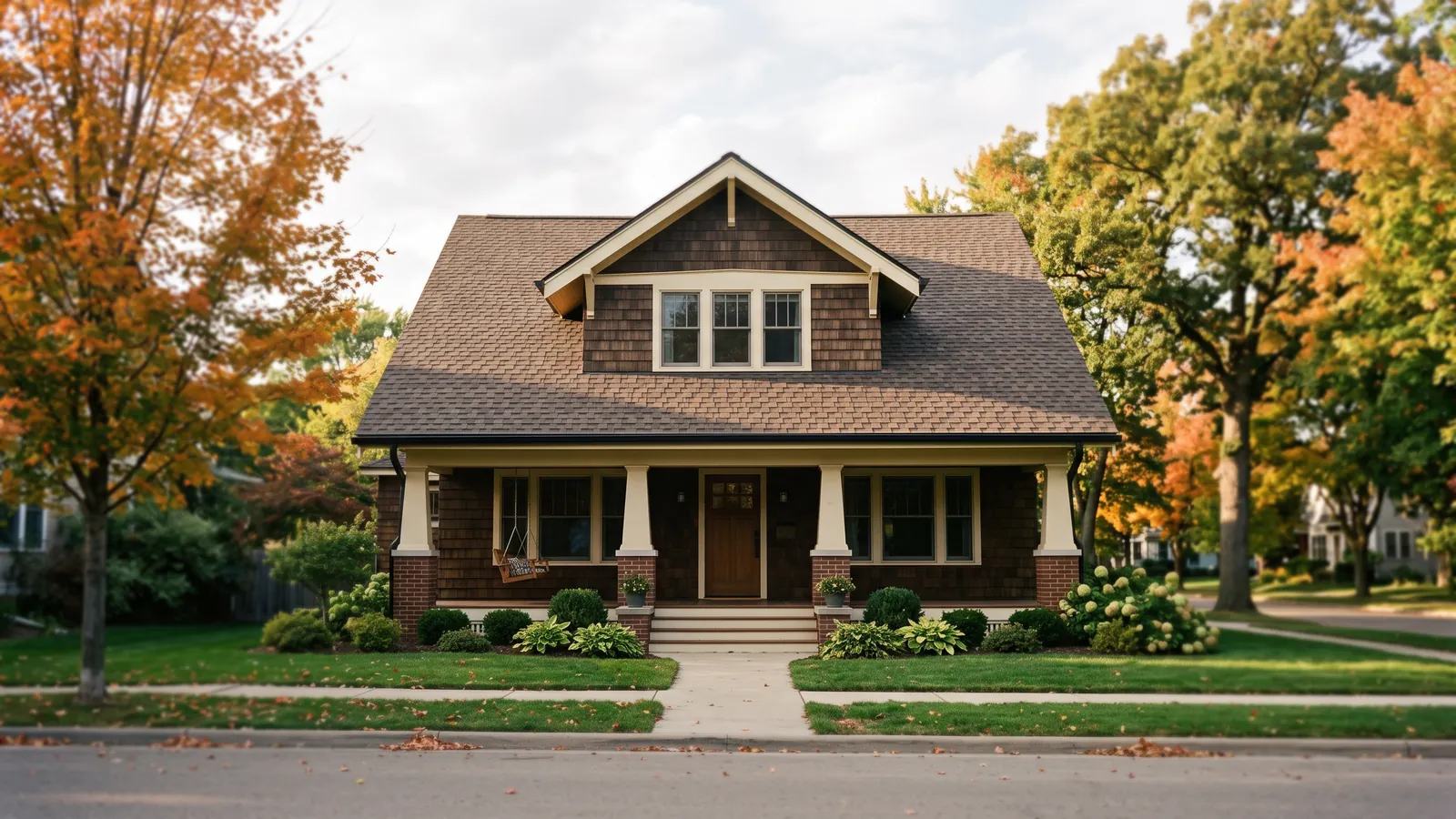
Flat Roof Membranes and Low-Slope Roof Work
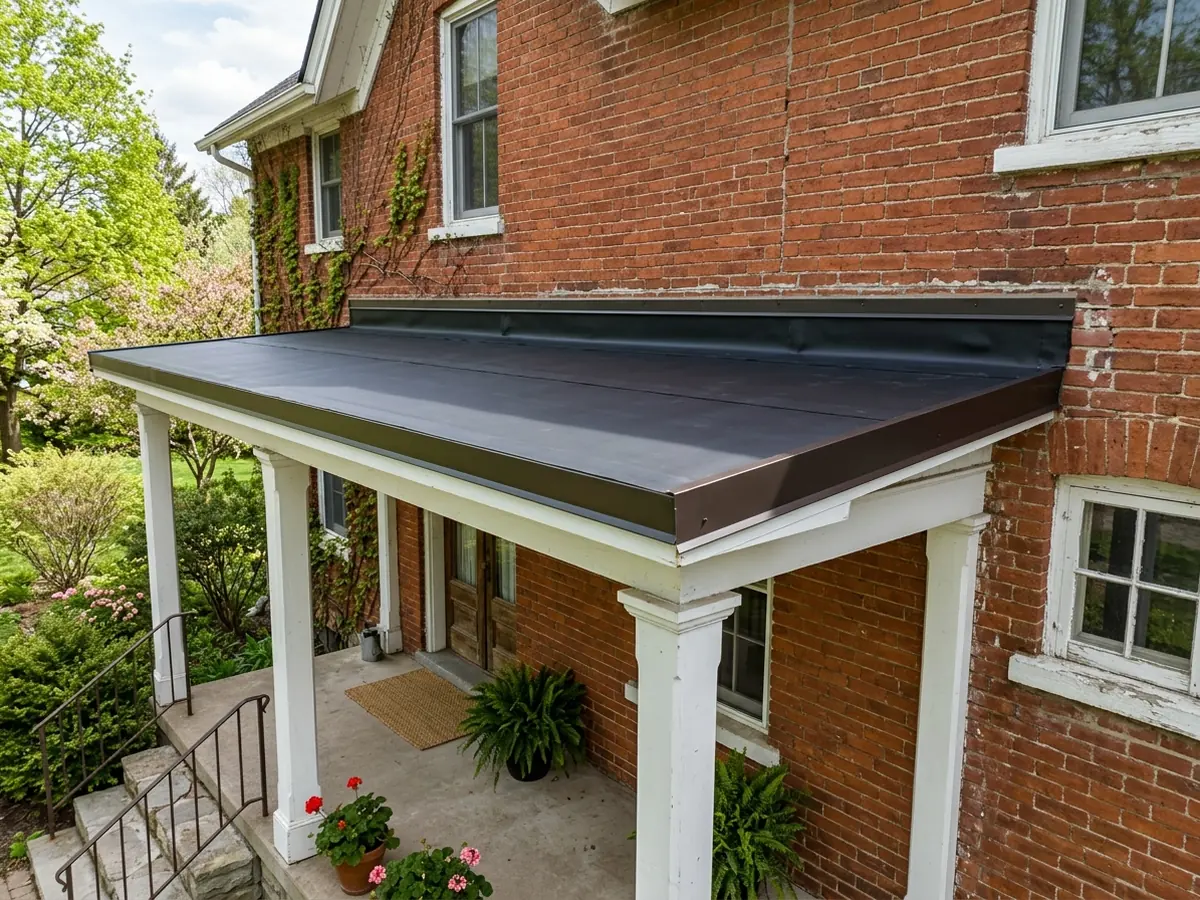
EPDM Rubber Roofing
EPDM is the black rubber sheet most people mean by "rubber roof." It comes in wide rolls, so a porch or garage roof often needs no seams at all, and where it does, the seams are glued or taped. It's either fully adhered to the insulation board, mechanically fastened, or held down by ballast on bigger roofs. Michigan's code calls it thermoset single-ply and requires it to meet ASTM D4637 or D5019.
HomeGuide puts EPDM at $4 to $10 per square foot installed and 15 to 20 years of service. Patching it is straightforward. The weak spots are the seams and the flashing where the rubber turns up a wall. Black rubber also soaks up summer heat, which a bedroom over a flat-roofed addition will notice; that's one reason people switch to a white sheet at replacement time.
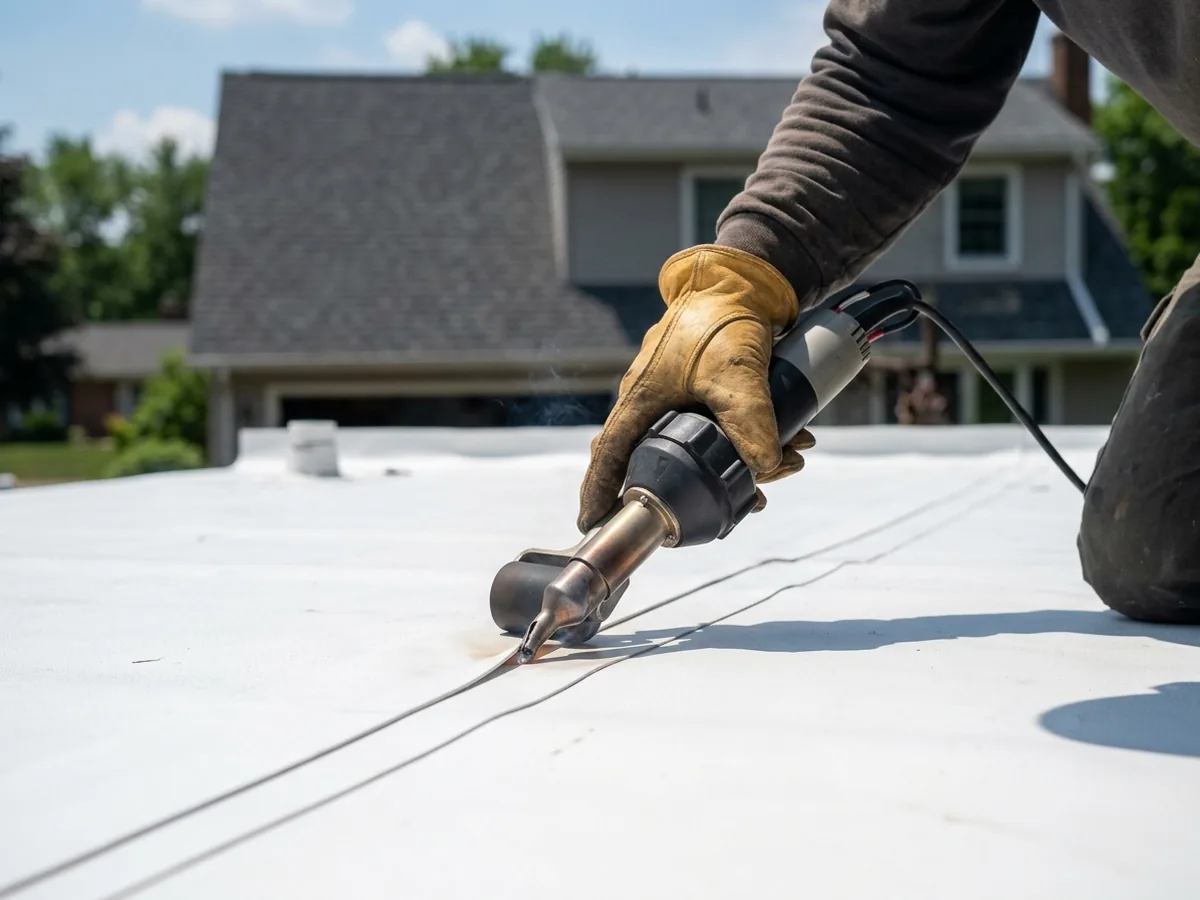
TPO Roofing
TPO is a white thermoplastic sheet. Its seams are melted together with a hot-air welder, so the finished roof is one continuous piece of plastic with no glue line to fail. The white surface reflects summer sun, which helps a room under a flat addition roof stay cooler. The code's standard for it is ASTM D6878.
HomeGuide gives TPO $4 to $10 per square foot and 10 to 25 years. PVC is the related premium sheet, also welded, at $5 to $12 and 20 to 30 years.
Modified Bitumen
Modified bitumen is asphalt reinforced with polymers, sold in rolls and applied in layers. The cap sheet carries mineral granules much like a shingle. It goes down with a torch, hot asphalt, cold adhesive or a self-adhesive backing. HomeGuide prices it at $4.00 to $7.50 per square foot and 10 to 20 years.
Our view: on a wood-framed porch or dormer attached to the house, ask for a self-adhered or cold-applied system instead of torch-down. Open flame next to old dry wood trim is a risk you don't need.
Flat Roof Repair: Seams, Ponding and Flashing
Most flat roof leaks start at the same few places: a seam that's opened, the flashing where the membrane turns up a wall or curb, a blister in modified bitumen, or a low spot where water sits after every rain. HomeGuide puts flat roof repairs at $300 to $1,100 on average and a minor leak at $150 to $500.
A repair holds only if the material underneath is dry. If the insulation board is soaked, a patch over it just traps the water. Ask the contractor to cut a small core or probe the soft area before quoting a patch, and to say in writing what they found. Wet insulation under a patch keeps the deck damp, and the next leak shows up a few feet away. If the membrane is sound but tired, a roof coating may extend it for a while.
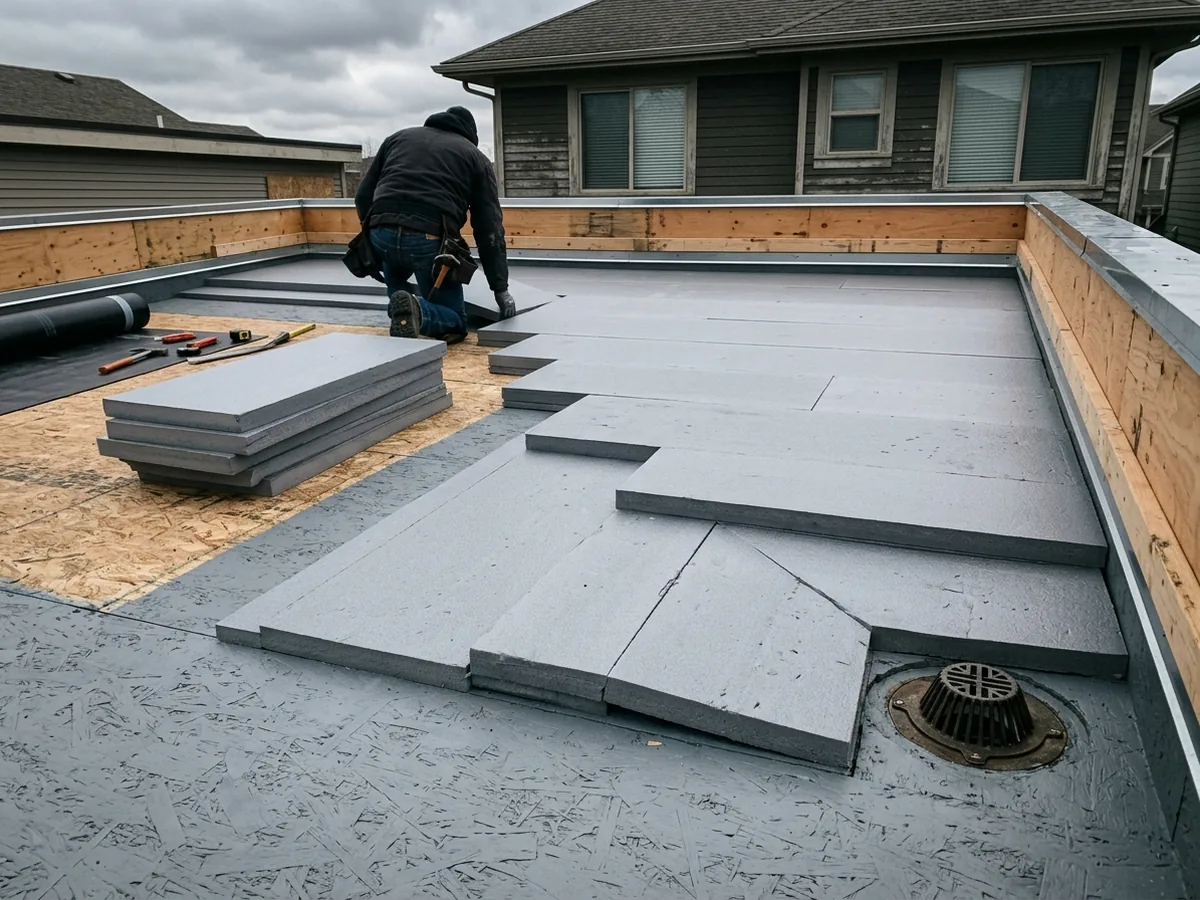
Tapered Insulation and Drainage
Michigan's code wants a membrane roof built to a design slope of at least 1/4 inch per foot for drainage, whether it's EPDM, TPO or modified bitumen. A roof that doesn't drain over its edge needs a drain at each low point, and where a raised edge or parapet could trap water, an overflow drain or scupper as well.
Plenty of older flat roofs were framed dead level or have sagged. Tapered insulation fixes that without reframing: polyiso boards cut at a slight angle, laid in a pattern that steers water to the drain, gutter or scupper. HomeGuide lists polyiso board at $0.50 to $3.00 per square foot and a roof drain at $70 to $340. On a re-roof, the code doesn't force an existing roof up to the 1/4-inch slope if it already drains, but our view is that a roof which ponds for days should get the taper while it's open.
Why Ann Arbor homeowners call Ann Arbor Roofing Co.
- Written estimate, free of charge
- Shingle line, underlayment and ice barrier named in the price
- Deck repair priced per sheet before the tear-off
- One independent local roofer per request, not a call list
- No fee to the homeowner for the referral
How Flat Is Too Flat for Shingles?
Michigan's residential code allows asphalt shingles only on slopes of 2:12 or steeper, meaning at least 2 inches of rise for every 12 inches across. Between 2:12 and 4:12, shingles are allowed but only over a double layer of underlayment. Below 2:12, the roof needs a membrane.
That line is why many older houses have two kinds of roof: a steep shingled main roof and a low porch, dormer or rear addition that should have a membrane but sometimes has shingles on it anyway. Shingles on a roof that's too flat leak at every lap once water backs up, usually in the first spring thaw. Measuring the pitch is a two-minute job with a level, and it decides which material the estimate can offer.
Flat Roof Replacement Cost
HomeGuide's national range for a residential flat roof replacement is $3 to $11 per square foot, or $4,000 to $16,800 for a typical job. Tear-off and disposal add $1 to $2 per square foot.
Flat roofs on houses are usually small, so the extras weigh heavily: edge metal, the flashing up the house wall, a new drain or scupper and any tapered insulation. A 200 square foot porch roof doesn't cost a tenth of a 2,000 square foot roof, because setup and flashing take the same time either way.
A flat roof estimate is easier to compare when it names the membrane and how it's held down (fully adhered, fastened or ballasted), the insulation type and thickness, whether tapered boards are included, the edge metal, and how high the membrane runs up any wall before the flashing covers it. Two quotes that leave those out can differ widely for reasons you can't see.
For garage and porch roofs specifically, see garage roof replacement. Apartment buildings and businesses with large flat roofs are covered on commercial roofing. If the main roof is shingled and also due, plan both together through roof replacement in Ann Arbor.